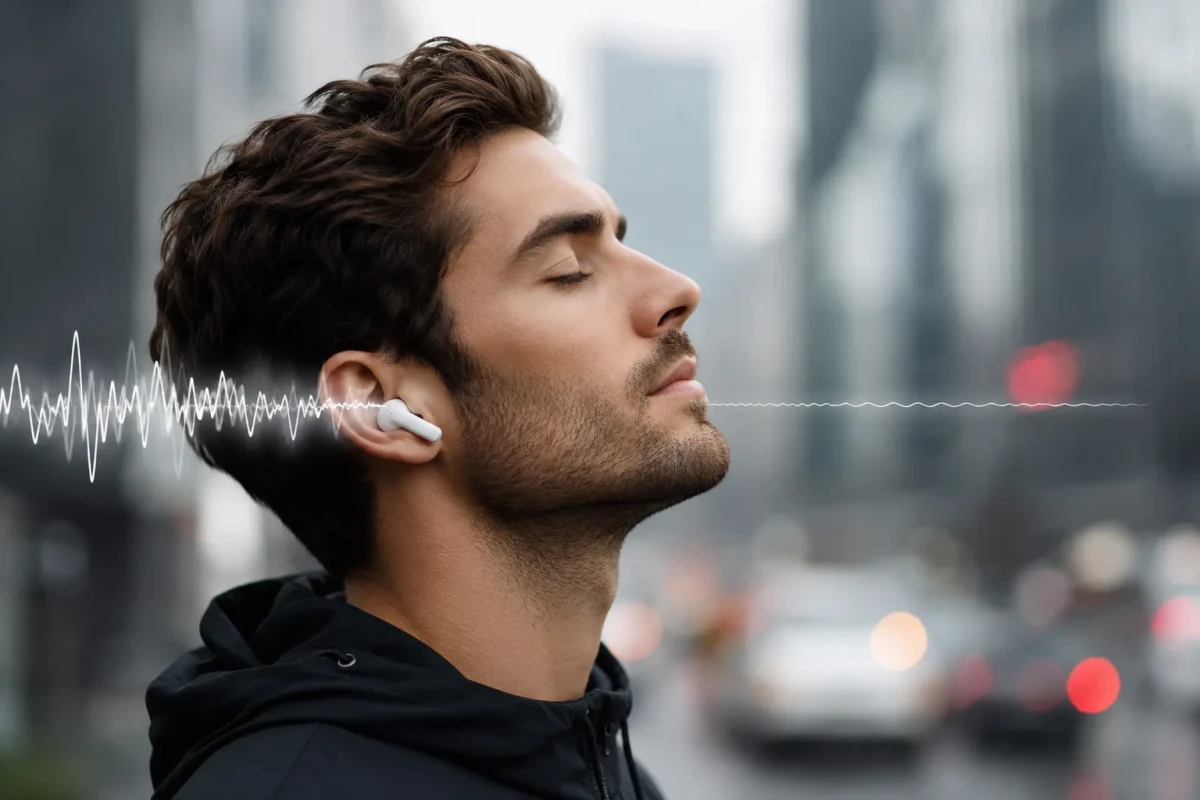
Featured Image: How does noise cancellation work – person wearing earbuds in noisy environment
Table of Contents
This comprehensive guide on how does noise cancellation work provides evidence-based strategies and practical tips you can start using today.
Noise cancellation technology has become a standard feature in headphones and earbuds, but how does it actually work? In the Trending Scenes category, understanding this technology helps you make better purchasing decisions. This guide explains noise cancellation in simple terms.
The Basic Principle: Anti-Noise
Noise cancellation works by creating “anti-noise” sound waves that cancel out unwanted ambient noise.
When two sound waves of equal amplitude but opposite phase meet, they cancel each other out through destructive interference. This is the same physics principle used in noise-cancelling headphones, just miniaturized for earbuds.
Think of it like two equal forces pushing against each other – they neutralize, leaving silence.
Active vs. Passive Noise Cancellation
There are two types of noise cancellation:
Passive Noise Cancellation:
- Uses physical barriers (ear cup padding, ear tip seal) to block sound
- No electronics required
- Most effective at blocking high-frequency sounds
- Present in all earbuds to some degree
Active Noise Cancellation (ANC):
- Uses electronics to generate anti-noise
- Requires microphones, processor, and battery
- Most effective at blocking low-frequency, constant sounds
- The two types work best combined for maximum noise reduction
How ANC Microphones Work
The ANC process happens in three steps, thousands of times per second:
- Listen – External microphones capture ambient noise
- Process – A chip analyzes the noise and calculates the exact opposite sound wave
- Cancel – The anti-noise wave is played through the speakers, canceling the original noise
This happens in microseconds – fast enough that your brain perceives it as silence. Modern ANC processors can handle multiple noise sources simultaneously.
Feedforward vs. Feedback ANC Systems
Different microphone placements create different ANC architectures:
- Feedforward ANC – Microphones outside the ear cup. Catches noise before it reaches your ear. Better at blocking external noise but can’t correct for errors.
- Feedback ANC – Microphones inside the ear cup. Corrects errors in real-time but has less time to react.
- Hybrid ANC – Uses both. The most effective system, found in premium earbuds. Combines the strengths of both approaches.
Most premium headphones and earbuds now use hybrid systems for the best performance.
What ANC Is Good At (and Not Good At)
Understanding ANC’s strengths and limitations helps set realistic expectations:
ANC excels at:
- Low-frequency, constant noises (airplane engines, train rumble, AC hum)
- Reducing overall noise floor by 20-30 decibels
- Long-duration exposure to noisy environments
ANC struggles with:
- Sudden, high-frequency sounds (conversations, dog barks, keyboard clicks)
- Very loud noises (construction, concerts)
- Wind noise (though newer models have improved wind noise reduction)
For the sounds ANC can’t block, passive isolation (good ear tip seal) is your best defense.
The Future of Noise Cancellation
Emerging ANC technologies include:
- AI-powered ANC – Learns your preferences and adapts to your environment automatically
- Personalized noise profiles – Based on your ear shape and hearing characteristics
- Bone conduction integration – For even better call quality in noisy environments
- Adaptive transparency – Lets important sounds through (sirens, announcements) while blocking others
- Lower power consumption – New processors use 50% less power, extending battery life
As processing power increases, ANC will become more effective while using less battery.
Frequently Asked Questions
Does noise cancellation damage your hearing?
No. ANC actually protects your hearing by reducing the need to turn up volume in noisy environments. The anti-noise waves are at safe levels. However, listening at high volumes for extended periods can damage hearing regardless of ANC.
Why does ANC cause ear pressure?
Some people experience a feeling of pressure or “ear suck” with ANC. This is because ANC removes low-frequency sounds that your brain uses to gauge air pressure. Most people adapt within a few minutes. If it persists, try reducing the ANC level or switching to transparency mode.
Does ANC work without music playing?
Yes. ANC works independently of audio playback. You can use it to reduce ambient noise even when not listening to music. Many people use ANC earbuds as earplugs for sleeping, studying, or working in noisy environments.
Explore More Categories
Discover more guides and tips across our content categories:
Final Thoughts
Noise cancellation is a remarkable technology that has become accessible to everyone. Understanding how it works helps you make better purchasing decisions and use it more effectively. The future of ANC is even more exciting.
Related Articles
How to Choose Wireless Earbuds
How to Connect Wireless Earbuds